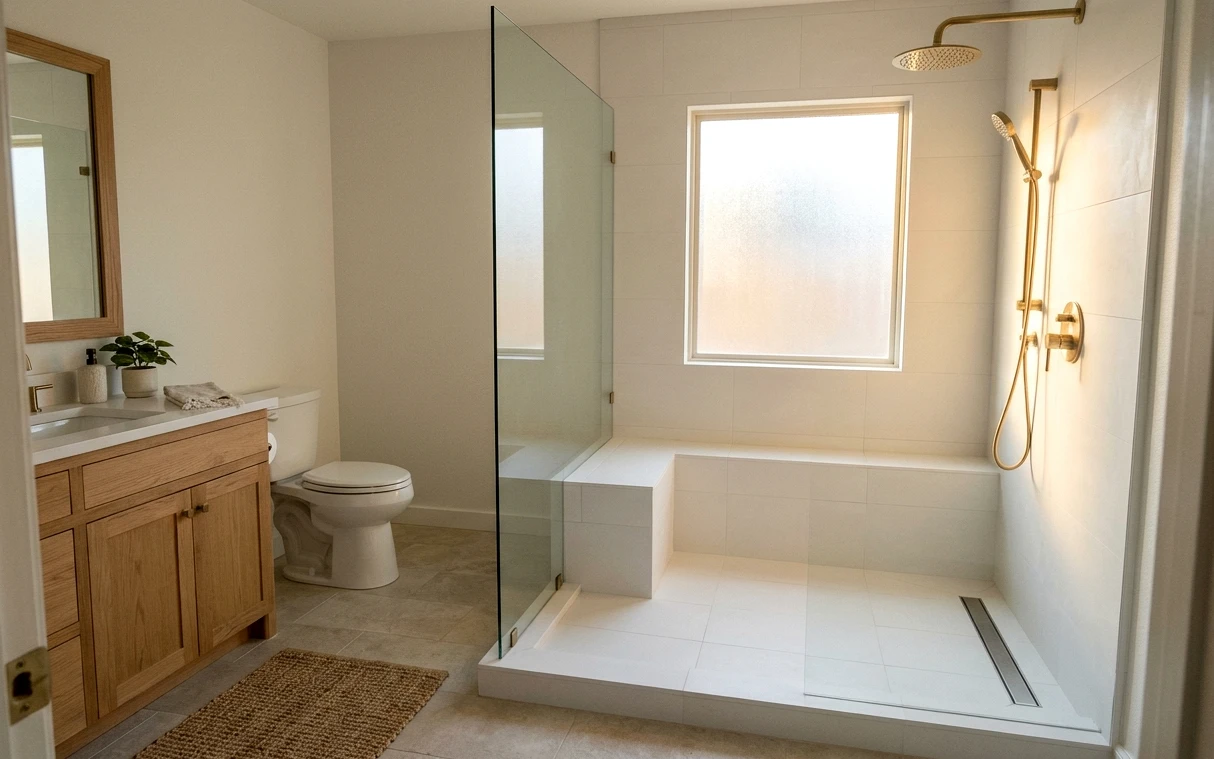
Who usually comes out ahead with a conversion
The happiest conversions we see share a pattern. The tub was used for storage, for bathing a dog or not at all. The household showers every day and wanted that daily routine to feel better.
Homeowners planning to stay put as they get older are another group. Stepping over a tub wall gets harder with a bad knee or hip, and a low-threshold shower with a bench and grab bars works well for decades.
- Couples or single adults who shower daily and rarely bathe
- Anyone with mobility, balance or joint concerns, now or ahead
- Hall baths with a cramped five-foot combo and a low shower head
- Primary suites with a rarely used garden tub eating floor space
The real advantages of trading the tub for a shower
A walk-in shower in the same footprint as a tub usually feels much larger, because the tub wall and curtain no longer chop the room in half. Glass opens the view across the whole bathroom.
It’s also easier to clean. One flat floor and a squeegee replace a tub ledge where soap scum and hard water scale build up. You also gain room for a niche, a bench, a handheld shower and better lighting.
The downsides people discover after the tub is gone
Conversions do have costs beyond the invoice. These are the ones we make sure every homeowner hears before demolition starts.
- Bathing toddlers in a shower is harder, and some parents miss the tub fast.
- Removing the only tub in the house can narrow the pool of future buyers.
- A shower floor needs a properly sloped pan, which means more work than a tub drop-in.
- Glass enclosures need regular wiping in San Antonio’s hard water.
- There’s no place for a long soak after yard work or a sore back.
Resale: does the one-tub rule matter here?
The common advice is to keep at least one bathtub in the house, and it’s sound. Many San Antonio buyers are families, especially in neighborhoods like Alamo Ranch, Converse and Cibolo where three- and four-bedroom homes are the norm. A house with no tub can still sell, but some buyers will cross it off quickly.
So the usual answer is to convert the bath you use most and leave a tub somewhere else. Converting a primary bath garden tub while keeping the hall bath tub covers both needs. If the hall bath is your only full bath, think twice before removing its tub.
Middle-ground options if you can’t decide
The choice isn’t always all or nothing. A few options sit between keeping a dated tub combo and removing the tub completely, and they suit households that are split on the question.
In a primary suite with enough room, a freestanding tub beside a larger walk-in shower gives both, though it takes more floor space than most hall baths have. In a smaller room, a new deep soaking tub with a tiled surround and a glass panel instead of a curtain refreshes the combo without giving anything up. Some homeowners also choose a low-profile tub with a lower wall, which is easier to step over and still holds water for a child’s bath.
Another path is timing. If young kids will outgrow bath time in a few years, refresh the combo now and plan the conversion later. Ask us to rough in the plumbing for a future shower layout if the walls are open anyway, so the later job is simpler.
- Freestanding tub plus separate shower in a large primary bath
- New tub with tiled surround and fixed glass instead of a curtain
- Low-wall tub that is easier to step into
- Refresh now, convert later, with plumbing planned ahead
Drain location is the hidden cost driver
A tub drain sits at one end of the tub. A shower drain usually goes in the center of the floor or along a linear channel at the back. On a slab foundation, moving that drain even a couple of feet means cutting the concrete, trenching, re-sloping the line and patching the slab.
Sometimes we can keep the drain close to the old location with an offset drain or a linear drain along the end wall. Other times moving it is worth it for a better shower. We explain more in our guide on slab foundations and moving drains.
What a tub-to-shower conversion typically costs
Most tub-to-shower conversions in San Antonio land between $11,850 and $27,400. That’s a planning range, not a quote, and a few decisions move it more than others.
- Keeping the drain in place versus moving it through the slab
- Tile height and size, from standard porcelain to floor-to-ceiling slab walls
- A curb versus a low-threshold or curbless entry
- A fixed glass panel versus a full hinged frameless door
- Add-ons like a bench, niche, grab bars, handheld wand and a new exhaust fan
- Repairs to rotted framing or subfloor found under the old tub
How the conversion usually runs, start to finish
Most conversions take one to three weeks of work, plus time for glass to be measured and made after tile is set.
- Design walkthrough: measure, check the drain and valve, and pick a layout.
- Demolition: remove the tub, surround and damaged drywall or backer board.
- Rough plumbing: set the new drain and valve, and get inspection if required.
- Shower pan and waterproofing: slope the floor and seal walls and pan.
- Tile: set floor and walls, then grout and seal.
- Glass and trim: measure glass after tile, then install it with the fixtures.
More questions on this topic
Will a tub-to-shower conversion hurt resale value in San Antonio?
It rarely hurts if another bathroom in the house keeps a tub. Removing the only tub can turn off some buyers, especially families with young kids. If you’re converting the primary bath and the hall bath still has a tub, most buyers won’t see it as a negative, and many prefer it.
Can a tub-to-shower conversion be done without moving the drain?
Often, yes. An offset drain or a linear drain along the back wall can sit close to the old tub drain, which avoids cutting much of the slab. Whether that works depends on the shower size and the drain’s exact position, which we confirm during the walkthrough.
How long will I be without a shower during a tub-to-shower conversion?
Plan on one to three weeks without that bathroom, depending on tile, drain work and inspections. Custom glass is measured after tile and can take extra time, though the shower is often usable with a temporary curtain before the glass goes in.
Is a tub-to-shower conversion a good idea for aging in place?
It’s one of the most useful changes for staying in a home long term. A low or no-threshold entry, a bench, a handheld shower and blocking for grab bars make daily showers safer. Our aging-in-place checklist covers the details worth planning while the walls are open.
Services this guide covers
Tub-to-Shower Conversion
Climbing over a tub wall gets old, and plenty of 60-inch alcove tubs see more showers than baths anyway. We convert that space into a step-in shower that fits the same footprint and works with the drain already in your slab.
Walk-In Shower Installation
A walk-in shower looks simple: tile, a drain and a sheet of glass. The part that decides whether it lasts is underneath, in the slope, the pan and the membrane, and that’s where we spend the most care.
Shower Pan Replacement
Wet baseboards outside the shower, loose floor tile, a musty smell, or a dark stain on the ceiling below usually trace back to one thing: a shower pan that has stopped holding water. Calls are answered 24/7, so you can reach us the moment you spot it.
Keep reading
Quartz or Granite? Choosing a Countertop for San Antonio Heat and Sun
Both are excellent counters. The differences show up in specific places: a hot pan, a sunny window, an outdoor kitchen, a busy cook who never reseals anything. Here is how they compare.
Reface, Paint or Replace Your Kitchen Cabinets: A Decision Guide
The answer usually depends on three things: what the cabinet boxes are made of, whether you like the layout, and how long you plan to stay. Here is how to test each one.
Keeping New Faucets, Glass and Showers Clear of San Antonio Hard Water
Our water comes from limestone, and it leaves a trace on everything it touches. A few choices made during a remodel decide how your new fixtures look a year from now.