Quartzite Is Not Quartz: Sorting Out the Names
The names sound alike and get mixed up in showrooms all the time. Quartzite is a natural metamorphic stone, sandstone that was heated and compressed until the grains fused. It’s quarried in blocks and sliced into slabs, so each one has its own veining. Engineered quartz is a manufactured slab of crushed quartz bound with resin; we cover that material on our engineered quartz page.
The practical difference is resin. Quartz contains it, which is why it can scorch or yellow under heat and sunlight. True quartzite has none, so it handles heat and UV far better. Be careful, though: some stones sold as quartzite are really soft dolomitic marble. We do a simple scratch test with a glass tile and an etch test with a drop of lemon juice on a sample before you commit.
Sintered Porcelain Slabs and What They Do Well
Sintered porcelain is made by pressing fine clays and minerals at very high pressure and firing them, which produces a dense, nonporous slab. It comes in thin formats, often 12 mm, and in finishes that imitate marble, concrete, soapstone and wood grain.
Porcelain doesn’t need sealing, shrugs off most stains, and won’t fade in sunlight. That makes it a strong pick for a breakfast bar under a west-facing window or an outdoor kitchen in South Texas heat. The trade-off is that the pattern on many porcelain slabs is printed on the surface, so a chipped edge shows a different color underneath. Through-body slabs cost more but hide chips better.
Porcelain slabs are also very large, often close to 10 feet long, which means fewer seams on a long run or a big island. That size cuts both ways: the slabs are heavy and flexible until they’re set, so carrying one through a narrow hallway in an older Monte Vista or Alamo Heights home takes planning, and sometimes a seam has to go where the doorway allows.
Heat, Sun and Wear: How They Compare Day to Day
For a household that cooks a lot, both materials take more abuse than most. Still, they behave differently, and the best choice depends on how you use the kitchen.
- Hot pans: both tolerate brief contact well; trivets are still smart for cast iron straight off a burner
- Sunlight: neither fades or yellows, unlike resin-based quartz
- Stains: porcelain is close to stain-proof; quartzite resists well once sealed
- Scratches: quartzite is very hard; porcelain is hard but its edges chip more easily
- Etching: real quartzite won’t etch from lemon or vinegar; marble-like look-alikes will
- Hard water: both clean up with a soft cloth and mild cleaner, without acids or abrasive pads
Edge Profiles That Suit Each Material
Quartzite can be shaped into most edge profiles: eased, beveled, half bullnose and ogee all work, though harder stone takes more shop time and costs more per foot. A mitered edge, where a strip is cut and joined at 45 degrees, makes the counter look 2 inches or thicker and keeps the veining flowing over the edge.
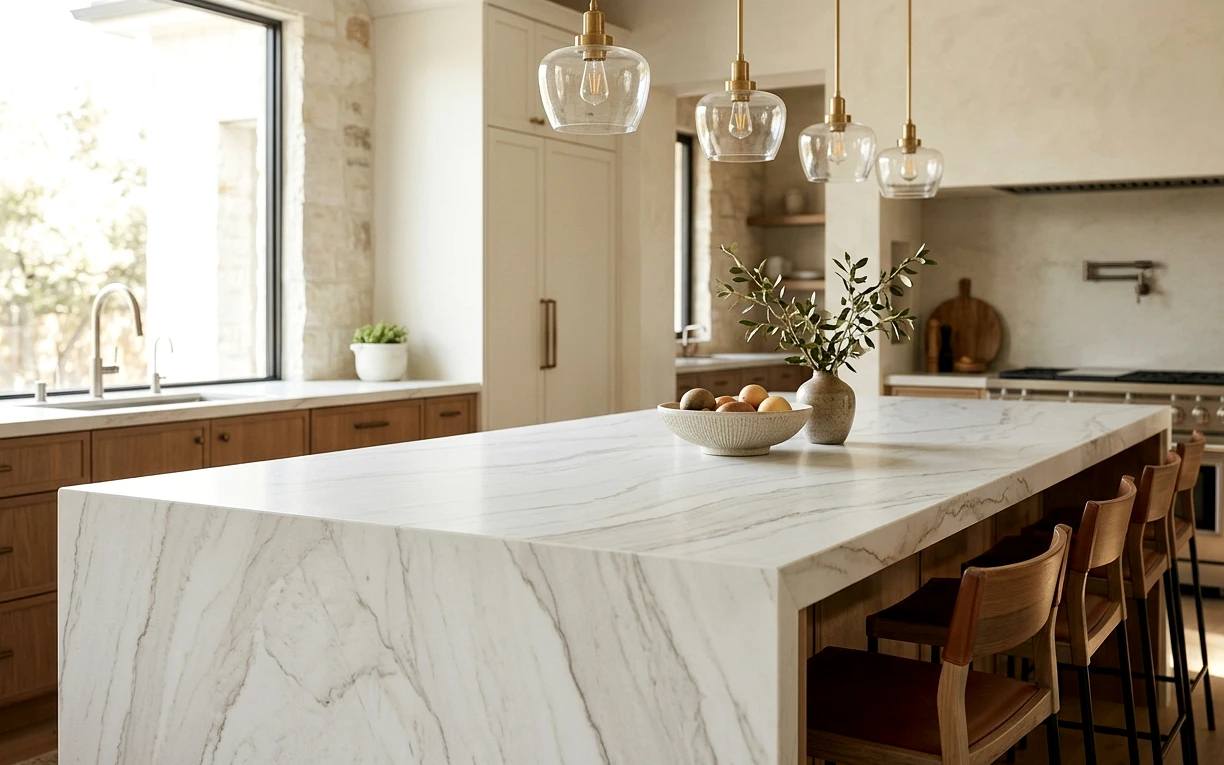
Porcelain is thinner and more brittle at the edges, so we lean toward eased or small beveled profiles. For a thicker look, the edge is mitered, and the joint has to be tight and well supported. Waterfall ends on an island look sharp in both materials and need a plan for book-matched veining across the corner.
Fabrication and Install: Where These Slabs Go Wrong
Both materials need experienced cutting. Quartzite is hard on blades and slow to polish. Porcelain can crack at sink and cooktop corners if the cutouts aren’t radiused and supported. That’s why we plan seam locations, overhang supports and cutouts at the template, not on install day.
Cabinets have to be flat before either slab goes on. On a slab foundation that has moved a little over the years, base cabinets are often out of level by more than you’d guess, and a thin porcelain top bridging a low spot can crack later.
- Select slabs in person and mark the veining or pattern you want featured
- Confirm sink, faucet, cooktop and outlet locations before templating
- Laser or physical template on the leveled base cabinets
- Lay out seams and cutouts on the slab, with radiused inside corners on porcelain
- Cut, edge, and dry-fit pieces at the shop, then deliver and set with full support
- Epoxy and color-match seams, mount the undermount sink, and seal quartzite
Sealing, Care and What to Avoid
Quartzite is denser than granite but still slightly porous, so we seal it after installation. Most homeowners reseal once a year or so; a quick water-drop test tells you when. Porcelain needs no sealing at all.
For both, skip harsh acid descalers, bleach-heavy sprays and scouring pads. A pH-neutral stone cleaner keeps them looking right. Don’t stand on porcelain or drop heavy pots on its edges. If you’re weighing these against granite, or wondering how they handle our climate, the Texas heat countertop guide lays out the comparison. Call us and we’ll set up a slab visit so you can see both side by side.
Projects that often go with quartzite and porcelain countertops
Quartz Countertops
Quartz gives you a consistent, low-maintenance surface that shrugs off coffee, wine and hard water spots. We plan the slab layout, seams and edges with you, then template and install once the cabinets are set and level.
Granite Countertops
Granite is natural stone, which means no two slabs match and the one you choose is the one you get. We help you pick slabs in person, lay out the cuts, and install a counter that stands up to hot pans and heavy use.
Kitchen Remodeling
A good kitchen remodel starts with the house, not a catalog photo. We design and build full kitchen remodels across San Antonio, sorting out layout, plumbing, power and permits before anyone picks a cabinet color.
Outdoor Kitchen Construction
An outdoor kitchen here has to survive months of triple-digit afternoons, sudden downpours and a sun that bleaches anything left uncovered. We build them with shade, heat-tolerant materials and properly run utilities from the first sketch.
Quartzite and Porcelain Countertops questions
How can I tell real quartzite from marble sold as quartzite at a San Antonio stone yard?
Ask for a sample and test it. Real quartzite scratches glass and won’t be scratched by a knife blade, and a drop of lemon juice left for a few minutes won’t dull the polish. Dolomite or marble labeled as quartzite fails one or both tests. We run these checks on samples before you buy.
Is sintered porcelain a good countertop for a kitchen with afternoon sun in San Antonio?
Yes. Porcelain has no resin, so strong sunlight won’t yellow or fade it, which makes it well suited to counters near west-facing windows, sunrooms and covered patios. Ask about through-body slabs if you’re worried about chips showing a different color at the edge.
Does quartzite need sealing, and how often?
Yes, quartzite is slightly porous and should be sealed after install. In most kitchens, resealing about once a year keeps oils and wine from soaking in. Drip some water on the busiest area; if it darkens the stone within a few minutes, it’s time. Porcelain doesn’t need sealing.
Are porcelain countertops more fragile than quartzite?
The flat surface is very hard and scratch resistant, but porcelain edges and corners can chip from a heavy knock. Thin slabs also need full, flat support underneath. Quartzite is tougher at the edges. With rounded edges and careful install, porcelain holds up well in an everyday kitchen.
Why do quartzite countertops cost more than many granites?
Quartzite is harder to cut and polish, which adds shop time and wears through tooling faster. Popular light, marble-look quartzites are also in high demand. Slab yield and seam planning to match veining add labor. Some porcelain slabs come in lower, though pricing varies by pattern.