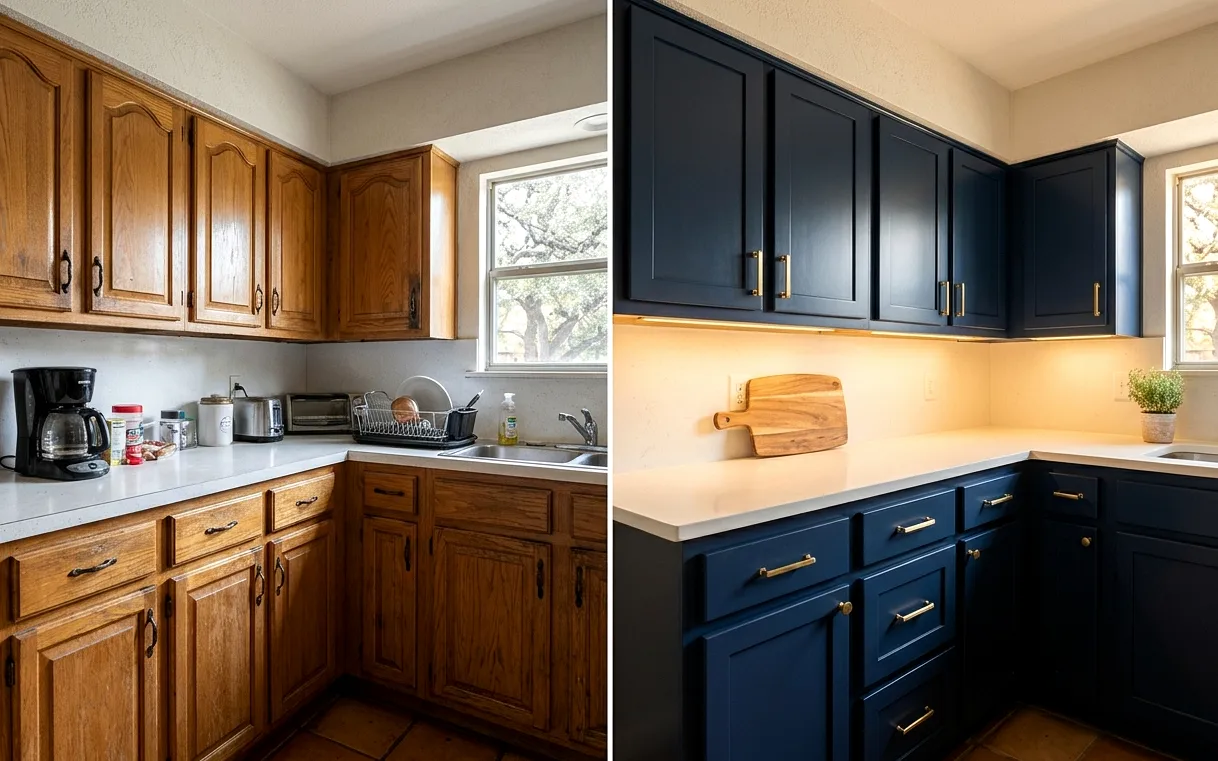
Three options, explained in one breath each
Painting keeps your doors, drawers and boxes, cleans and sands them, then sprays a durable finish. Refacing keeps the boxes but replaces every door and drawer front, covers the frames with matching veneer, and usually adds new hinges and pulls. Replacing tears everything out and builds a new set of cabinets, often in a new layout.
Each option costs more than the one before, and each one changes more of the room. The trick is matching the option to what’s actually wrong with the kitchen you have.
Test one: are the boxes worth keeping?
Open every base cabinet and look inside, especially under the sink. The boxes are the frame for everything else, and refacing or painting only makes sense if they’re sound.
Plywood or solid wood boxes from the 1970s through the 1990s are often in better shape than people expect. Particleboard boxes, especially under a sink that has leaked, may be swollen, soft or crumbling. In a home that has had a slab leak or a dishwasher leak, check the bottoms of the cabinets nearest the water.
- Swollen, bubbled or soft particleboard
- Water stains or mold on cabinet floors
- Face frames pulling away from the boxes
- Shelves that sag in the middle
- Drawer boxes coming apart at the corners
- Cabinets that are out of level or pulling off the wall
Test two: does the layout work for how you cook?
This is the question that decides most cases. Refacing and painting give you a new look, but every cabinet stays exactly where it is. If the dishwasher is in a corner where its door blocks a drawer, or the fridge is too far from the sink, a new finish won’t fix that.
Picture a normal weeknight in the kitchen. If you’re constantly working around the room’s problems, replacement is the honest answer. If the layout feels fine and you just dislike the oak, refacing or painting is probably the right call.
- Is there enough counter space next to the range and sink?
- Can two people work without bumping into each other?
- Do the upper cabinets reach a useful height, or is there a soffit above them?
- Is there room for the appliance sizes you want?
- Would you add an island or remove a wall if you could?
Test three: how long are you staying?
If you’re planning to sell in a few years, a clean painted finish or refacing can make the kitchen look current for a fraction of the cost. Buyers notice fresh, neutral cabinets more than they notice whether the boxes are original.
If this is the house you’ll stay in for a long time, think about what you’ll want in fifteen years. Replacement lets you add deep drawers, pull-outs, a better pantry and better construction, choices that pay off with years of daily use.
What each option costs in a typical San Antonio kitchen
These ranges assume a kitchen of about 25 to 35 linear feet of cabinets. They’re planning figures, not quotes, and the factors that move them are listed underneath.
Painting usually runs $4,350 to $9,850. Refacing runs $8,650 to $21,300. Replacement runs $16,900 to $54,700 for the cabinets and installation alone, before countertops. Fully custom or inset cabinets can go higher.
- Number of doors and drawers, more than kitchen size alone
- Door style and material, from flat slab to detailed shaker
- Whether you add soft-close hinges, slides and organizers
- Paint type and whether doors are sprayed off-site
- Whether replacement forces new counters, flooring or backsplash
- Repairs needed on the boxes before refacing
How refacing and painting jobs actually run
Both options are far less disruptive than replacement, which is part of their appeal. The kitchen stays usable for most of the job, and there’s no demolition dust or empty wall to live with.
For refacing, we measure every opening, order new doors and drawer fronts, then return to apply veneer to the frames and hang the new pieces. For painting, doors and drawers usually come off and get sprayed in a controlled space, while the frames are prepped and finished in place. In San Antonio summers, humidity affects how paint cures, so timing and ventilation get extra attention.
- Walkthrough to check boxes, measure and choose a door style or color
- Ordering doors and fronts for refacing, or color testing for paint
- Protecting counters, floors and appliances
- Removing doors, drawers and hardware
- Veneering or painting the frames and box sides
- Hanging new or finished doors, adjusting hinges and adding pulls
The hidden domino: what happens to your counters
Here’s the part people miss. Painting and refacing leave your countertops in place. That’s great if you like your counters, and it keeps costs down. But if the counters also need replacing, the math changes.
Once you’re buying new counters and possibly a new backsplash, the price gap between refacing and replacing narrows. That’s often the moment it makes sense to go all the way and fix the layout too. On the other hand, if you put in new granite or quartz recently, refacing the cabinets lets you keep it. Our kitchen cost guide shows how the full-remodel bands compare.
A quick way to make the call
If the boxes are sound, the layout works, and the counters are staying, reface or paint. If the boxes are failing, the layout fights you, or everything is being replaced anyway, replace.
Still on the fence? Give us a ring and a designer can open the doors, check the boxes and look at the layout with you. Seeing the cabinets in person usually settles it quickly, and we’ll tell you honestly if the boxes aren’t worth saving.
More questions on this topic
Is refacing kitchen cabinets worth it compared with new cabinets in San Antonio?
It’s worth it when the boxes are solid and you like the layout. You get new doors, drawer fronts and hardware, plus a fresh look, often for roughly half the cost of replacing. If the boxes are water-damaged or the layout doesn’t work, refacing puts new faces on old problems.
How long does painted cabinetry last in a busy kitchen?
A properly prepared, sprayed finish with a durable cabinet coating can look good for many years. Chips tend to show first on the doors and drawers you use most, near the sink and trash. Touch-ups are simple if you keep a small amount of the paint.
Can I add new cabinets to a refacing project to change the layout slightly?
Yes, within limits. We can add a cabinet at the end of a run, build a small island or swap a unit for a pantry pull-out, then reface everything to match. Big changes, like moving the sink or range, usually make full replacement the better choice.
Services this guide covers
Cabinet Refacing
If your cabinet boxes are sturdy and the layout works, there’s no reason to haul them to the landfill. Refacing puts new doors, drawer fronts and veneer on what you already have, usually without touching the countertops.
Cabinet Painting
Paint is the cheapest way to change how a kitchen feels, and the easiest to get wrong. We clean, sand, prime and spray your cabinets with a hard finish, then let it cure before the doors go back up.
Custom Kitchen Cabinets
Stock cabinets come in three-inch steps, and real kitchens rarely do. We design custom cabinets around your walls, appliances and the way you cook, so the filler strips disappear and every inch does a job.
Keep reading
Keeping New Faucets, Glass and Showers Clear of San Antonio Hard Water
Our water comes from limestone, and it leaves a trace on everything it touches. A few choices made during a remodel decide how your new fixtures look a year from now.
Slab Foundations and Moving Drains During a San Antonio Remodel
Most San Antonio homes sit on a concrete slab, and every drain runs through it. Moving one is doable, but it helps to know what happens under the floor before you approve a new layout.
Do You Need a Permit for a Kitchen or Bath Remodel in San Antonio?
Permits sound like paperwork, and mostly they are. But they also mean someone checks the parts of the job you’ll never see again once the drywall is closed.