Why San Antonio water is so hard on bathrooms and kitchens
Most of the city’s water is drawn from the Edwards Aquifer, which runs through limestone. As water moves through that rock it picks up calcium and magnesium. When the water evaporates on a shower door or a faucet spout, those minerals stay behind as the chalky white crust everyone here knows.
Heat makes it worse. Water heaters, dishwashers and hot shower lines scale faster than cold lines, which is why the showerhead clogs before the toilet fill valve does. Nothing here is a defect in your plumbing. It’s simply what local water does.
Signs hard water is already costing you money
Before a remodel, we look for clues about how hard the water is treating the house now. These signs help decide whether a softener or filter belongs in the plan.
- Glass shower doors that stay cloudy even right after cleaning
- Showerheads with blocked nozzles that spray sideways
- Faucets that drip or turn stiffly after only a few years
- White rings around drains and at the base of faucets
- A water heater that pops or rumbles while heating
- Spots on dishes and a film inside the dishwasher
Fixture choices that hold up to mineral-heavy water
Some fixtures shrug off scale better than others. When we help homeowners pick faucets and showerheads, these are the features we look at first, ahead of style.
Ceramic disc cartridges are the big one. They resist mineral wear far better than older rubber washer designs, so the faucet keeps turning smoothly. Showerheads with soft rubber nozzles let you rub scale off with a thumb instead of soaking the whole head in vinegar.
- Ceramic disc valve cartridges in every faucet and shower valve
- Rubber or silicone spray nozzles on showerheads and hand showers
- Pull-down kitchen sprayers with wipe-clean faces
- Toilets with simple, replaceable fill valves
- Aerators you can unscrew by hand for cleaning
Finishes and glass that hide water spots
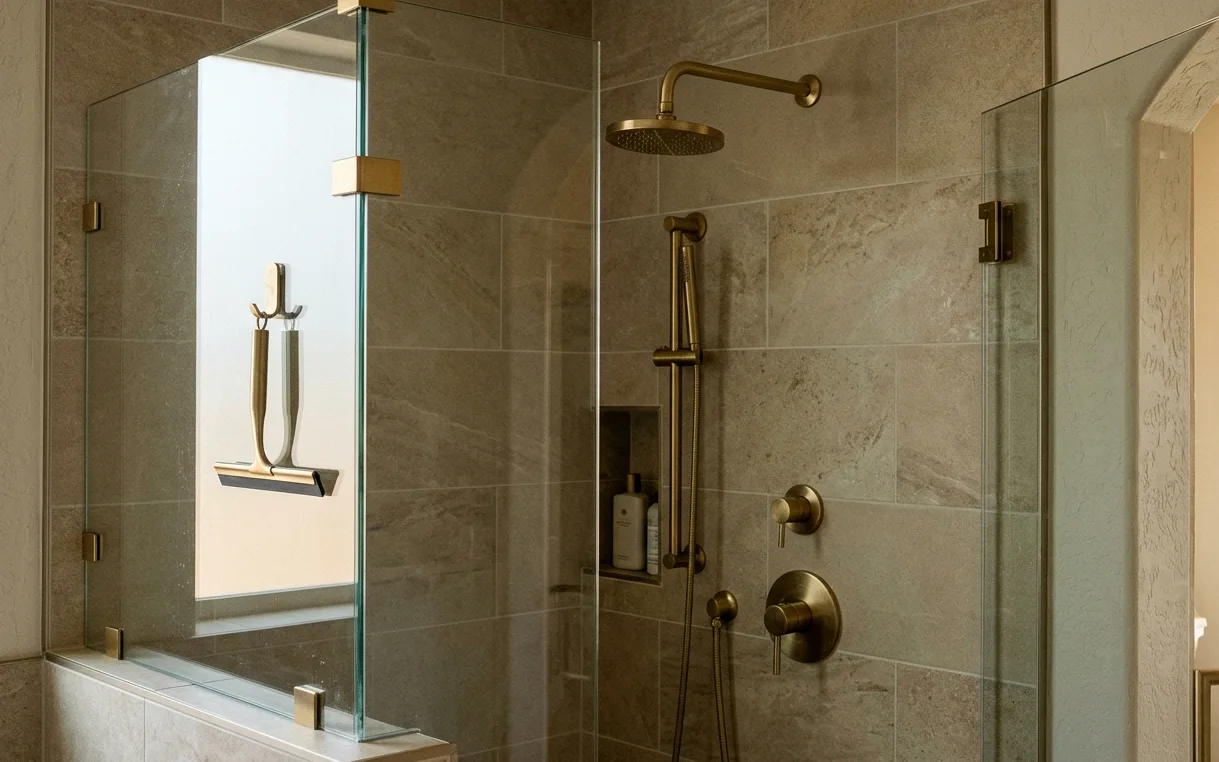
Polished chrome and matte black both show white spots clearly, just in different ways. Brushed nickel, brushed brass and stainless finishes hide light scale between cleanings. If you love matte black, go in knowing it will need wiping more often.
Glass is the hardest surface to keep clear in a San Antonio shower. A factory-applied protective coating on new frameless shower glass slows the buildup a lot, and a fixed panel with fewer edges is easier to wipe than a framed sliding door with tracks. Clear glass shows scale. Lightly textured or fluted glass hides it, at the cost of a less open look.
Tile matters too. Glossy dark tile shows every mineral streak, while matte, mid-tone tile hides them. Epoxy or high-performance grout resists staining better than plain cement grout in a shower that gets hard water daily.
Softener, filter or neither: how to decide
A whole-house water softener is the most complete answer. It removes hardness before water reaches any fixture, which protects the water heater, the dishwasher and every new faucet at once. Many San Antonio homes already have a softener loop near the garage or water heater, which makes adding one simpler.
A point-of-use filter, like a showerhead filter or an under-sink unit, is a smaller step. It helps one fixture but doesn’t protect the rest of the house. Some homeowners skip treatment altogether and commit to wiping glass and descaling fixtures on a schedule. That works too, as long as you know the trade.
- Check whether the house already has a softener loop or bypass valve.
- Decide whether you want to protect the whole house or just the new bathroom.
- Leave space and drain access near the water heater if a softener is likely.
- Plan any new water heater and softener while the walls are already open.
Plumbing details to settle during the remodel
Hard water is easier to manage when the plumbing is built with it in mind. During a bathroom remodel we pay attention to small details that make future maintenance easier.
We install accessible shutoff valves at every fixture so a cartridge swap doesn’t mean shutting off the whole house. We choose shower valves with replacement parts that are easy to find. We place the main shower control where you can reach it without stepping under cold water.
In the kitchen, the same thinking applies to the sink and faucet. An undermount sink with no rim lets you wipe scale straight into the bowl, and a faucet with a single mounting hole leaves fewer crevices for minerals to collect. If a refrigerator with an ice maker is going in, we suggest a filter on that line, because scale clogs small valves quickly.
A simple cleaning routine that keeps new fixtures looking new
The routine matters more than the product. Even with a softener, a quick daily habit keeps scale from settling in. Without one, it’s the difference between a door that looks new and one that turns cloudy within a year.
- Squeegee the glass and tile after every shower.
- Wipe faucets dry once a day with a soft cloth.
- Once a month, wipe glass and fixtures with diluted white vinegar, then rinse well.
- Twice a year, unscrew aerators and showerhead faces and soak them in vinegar.
- Avoid abrasive pads and harsh acids, which damage finishes and glass coatings.
When scale means it’s time to replace, not clean
Some fixtures are past saving. If a faucet still drips after a new cartridge, or a glass door has etched rather than just scaled, cleaning won’t bring it back. Etching feels rough even after vinegar and shows as a permanent haze.
If you’re weighing a replacement or planning a full remodel and want to talk through softeners, glass and fixtures for your house, give us a ring. We’ll look at what the water has already done and plan the new room to stand up to it.
More questions on this topic
Will a water softener protect new bathroom fixtures from San Antonio hard water?
A whole-house softener removes most of the minerals that cause scale, so it protects faucets, showerheads, glass and the water heater all at once. You’ll still want to wipe glass now and then, because even softened water leaves light spots, but the heavy white crust mostly stops.
What faucet finish holds up best to hard water in San Antonio kitchens?
Brushed finishes, such as brushed nickel, brushed brass and stainless, hide light mineral spots between cleanings better than polished chrome or matte black. Look for ceramic disc cartridges inside, since those resist mineral wear and keep the handle turning smoothly for years.
Can hard water etch new frameless shower glass?
Yes. If scale sits on glass long enough, it can etch the surface and leave a haze that no cleaner removes. A factory protective coating slows that process, and a daily squeegee prevents it. Once glass is etched, replacement is usually the only fix.
Services this guide covers
Kitchen Sink and Faucet Replacement
A dripping faucet crusted with white scale is a very San Antonio problem. We replace kitchen faucets and sinks with fixtures that handle hard water, swap tired shutoff valves, and leave the cabinet below dry and tidy.
Frameless Glass Shower Doors
Heavy, clear glass with minimal hardware makes a shower look larger and lets the tile show. In a city with water this hard, though, the glass you pick and how you care for it matter as much as how it looks on day one.
Shower Replacement
Swap a cracked insert, a tired tile stall, or a leaky old valve for a new shower in the same footprint. We open the wall, fix what’s hiding behind it, and rebuild with materials that handle hard water.
Keep reading
Slab Foundations and Moving Drains During a San Antonio Remodel
Most San Antonio homes sit on a concrete slab, and every drain runs through it. Moving one is doable, but it helps to know what happens under the floor before you approve a new layout.
Do You Need a Permit for a Kitchen or Bath Remodel in San Antonio?
Permits sound like paperwork, and mostly they are. But they also mean someone checks the parts of the job you’ll never see again once the drywall is closed.
An Aging-in-Place Bathroom Checklist, Zone by Zone
The best accessible bathrooms don’t look clinical. They just work on a bad-knee day, at two in the morning, and twenty years from now. Walk your own bathroom with this list.