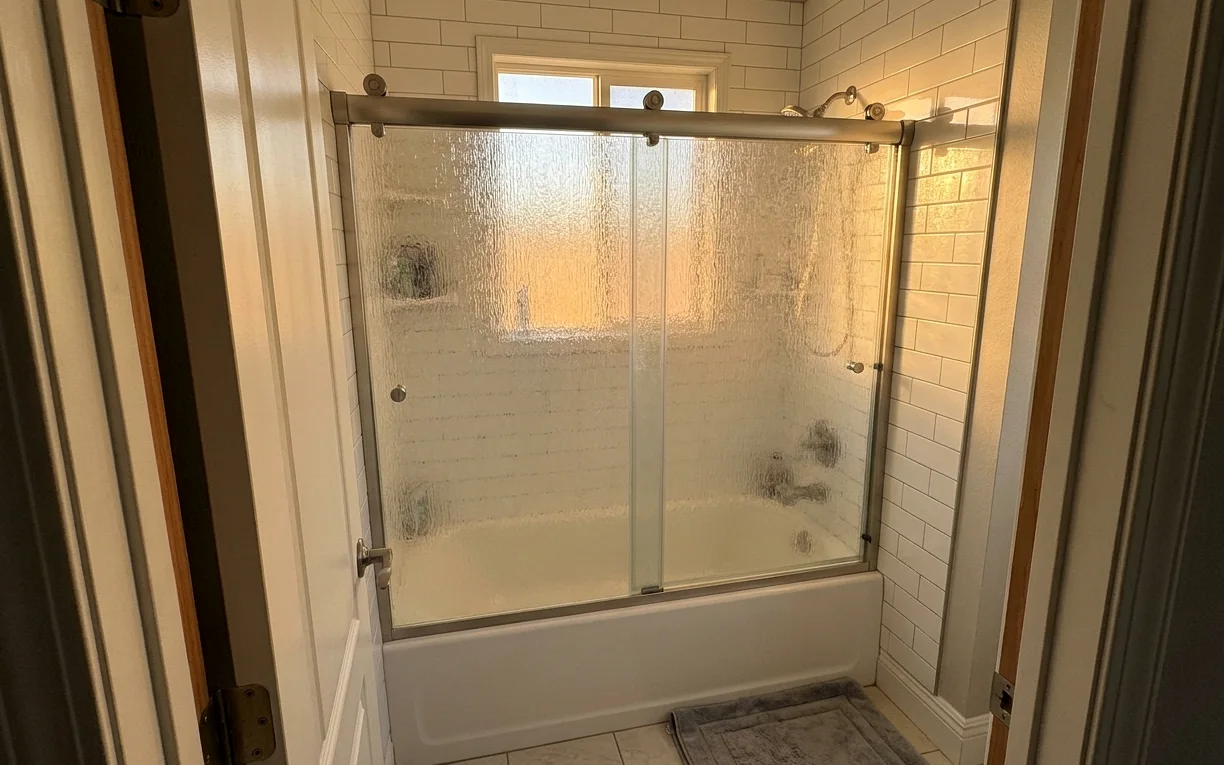
Framed and Semi-Frameless Doors Versus Full Frameless Glass
Framed doors wrap the glass in a metal channel on every side. The frame carries the weight, so the glass can be thinner, usually 3/16 or 1/4 inch, and the price stays down. Semi-frameless doors drop the frame around the moving panel but keep a header or side jambs, which gives a lighter look while still using standard hardware.
Full frameless glass is a different product: thick tempered glass, heavy hinges into the wall, and a custom cut to your exact opening. If that’s the look you’re after, see our frameless glass enclosures page. This page covers the more budget-friendly door types that suit most tubs, rental baths, kids' baths and standard alcove showers.
Which Door Style Fits Your Opening
The right door depends less on taste than on the size of the opening and the room in front of it. A swing door that hits the toilet or vanity every morning gets old fast, so we measure clearance before talking finishes. In a lot of 1980s and 1990s tract homes, the hall bath has barely enough room between tub and toilet for anything but a slider.
- Sliding bypass doors: two panels on a track, the usual choice for 60 inch tub combos and wide alcoves where nothing can swing
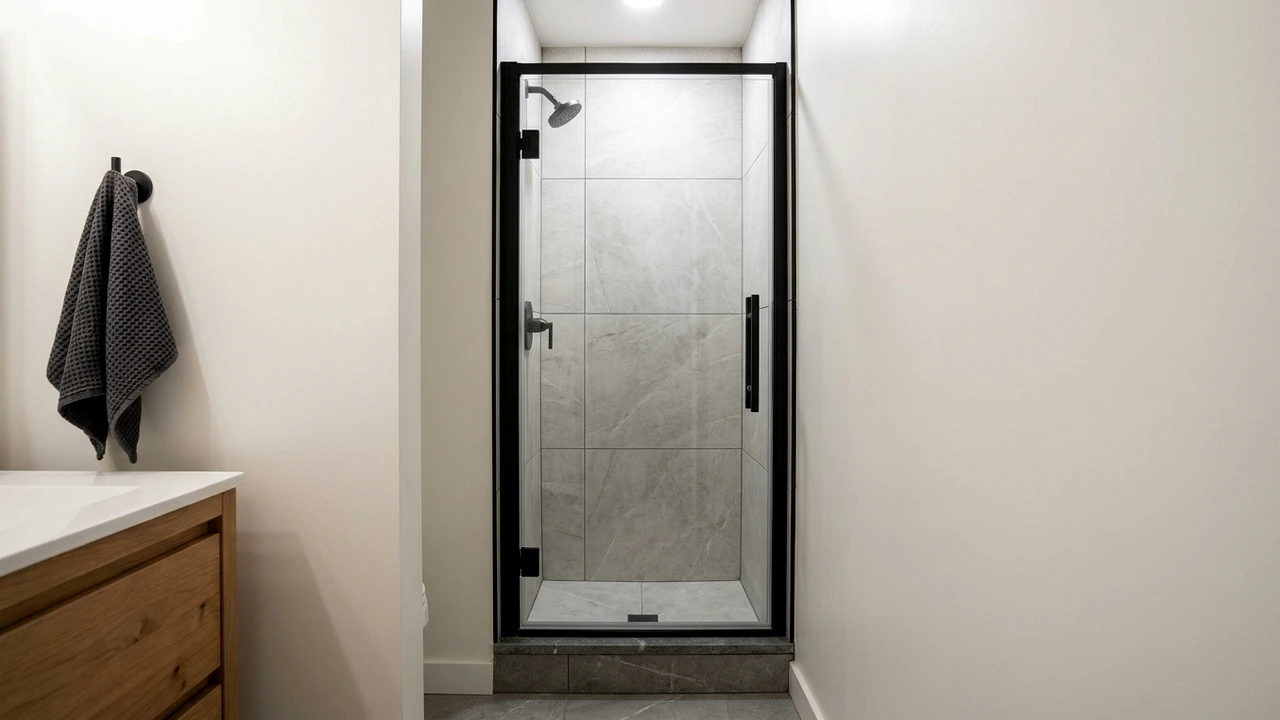
- Pivot doors: one panel turning on top and bottom pins, good for narrow stall showers around 28 to 36 inches
- Hinged doors with an inline panel: a swing door beside a fixed piece, for wider showers with room to open outward
- Tub doors with a fixed splash panel: a short fixed section by the faucet and a swing or slide section for access
- Neo-angle doors: for corner showers with angled walls, framed or semi-frameless
Glass Texture, Frame Finish and the Hard Water Question
Clear glass shows off the tile, but it also shows every mineral spot San Antonio water leaves behind. Rain, frosted or obscure patterns hide spotting well and add privacy in a shared bath. A factory protective coating is worth adding on clear glass, because it helps water sheet off before it dries.
Frame finishes run from silver and chrome to brushed nickel, oil-rubbed bronze and matte black. Brushed and matte finishes hide water marks better than polished ones. Look at the bottom track too: deep, square tracks trap scale and soap film, while low-profile or rounded tracks are far easier to wipe out.
Old aluminum tracks crusted with years of scale are one of the most common reasons people call us. Most of that buildup comes from water sitting in the track, so a weep hole design and a quick squeegee after showers make a real difference.
What Happens When We Pull an Old Door Off
Removing a 20-year-old framed door usually reveals something. Silicone behind the jambs is often black with mildew, screw holes may have let water into the wall, and the tile edge or tub ledge under the track can be cracked.
We cut out the old caulk, clean the surfaces with a mildew remover, fill or seal old anchor holes, and check that the tub ledge or curb isn’t pitched outward. If grout around the opening is crumbling, we’ll point that out; a light regrout around the opening before the new door goes up keeps water out of the wall. If tile is loose or the wall feels soft, the door should wait until that’s repaired.
Steps for a Typical Door Installation
Most stock doors are sized to common openings and arrive within days. Odd sizes or semi-frameless models may be cut to order, which adds a short wait.
- Measure the opening at the top, middle and bottom and check the walls for plumb
- Choose style, glass pattern, finish and handle side
- Remove the old door, old silicone and anchors, then clean and dry the surfaces
- Set the bottom track or threshold and fasten the wall jambs into solid backing
- Hang the panels, adjust rollers or hinges so the door closes evenly
- Install sweeps and seals, then run silicone along the outside of the jambs and track
- Let the silicone cure before the first shower
Getting the Most Years Out of a New Shower Door
Doors fail in small ways first: a roller that starts to grind, a sweep that curls, a magnetic strip that stops catching. Most of those parts are replaceable, so ask for the model information and keep it. A squeegee and a weekly wipe of the track keep scale from locking up rollers.
If you’re updating the whole shower, put the door on the schedule last, after tile, grout and any shower rebuild are done, so it’s measured to finished surfaces. Call us and we’ll measure your opening and bring samples of glass patterns and frame finishes to the walkthrough.
Projects that often go with shower door installation
Frameless Glass Shower Doors
Heavy, clear glass with minimal hardware makes a shower look larger and lets the tile show. In a city with water this hard, though, the glass you pick and how you care for it matter as much as how it looks on day one.
Shower Replacement
Swap a cracked insert, a tired tile stall, or a leaky old valve for a new shower in the same footprint. We open the wall, fix what’s hiding behind it, and rebuild with materials that handle hard water.
Regrouting and Tile Repair
Stained, crumbling grout and a few cracked tiles don’t always mean a new bathroom. Often a careful regrout, fresh caulk and a handful of replacement tiles bring a shower back, as long as the problem stops at the surface.
Bathroom Remodeling
A bathroom remodel succeeds or fails behind the tile. We plan the layout, drains, waterproofing and ventilation first, then help you pick the finishes, so the room looks good on day one and still works years from now.
Shower Door Installation questions
Is a sliding bypass door or a curtain better on a San Antonio tub and shower combo?
A bypass door keeps water off the floor better and lasts for years, while a curtain is cheaper and easier for bathing small children. For a tub used mostly as a shower, a door is usually worth it. Pick a low-profile track so hard water scale is easy to clean out.
How much does it cost to replace a framed shower door with a semi-frameless door?
Semi-frameless doors usually land in the upper half of our range, roughly $1,180 to $2,370 depending on size, glass and finish. Removing the old frame and repairing caulk or tile edges can add to that. It’s still well below the cost of full frameless glass on most openings.
Can a pivot shower door work in a small stall shower?
Yes, pivot doors are a good fit for narrow stalls because the single panel swings on pins without needing a wide clearance. We check that the door can open outward fully without striking the toilet, vanity or towel bar. Some pivot doors can be set to swing either direction.
Why do shower door tracks get so crusty in San Antonio, and can a new track help?
Hard water sits in the bottom track and leaves mineral layers each time it dries, and soap film builds up with it. A new low-profile or rounded track with weep holes drains faster and wipes clean easily. Squeegeeing the glass after showers keeps most of that water out of the track.
Do you install shower doors on a tub that has a curved or sloped ledge?
Usually. Many tubs have a slight slope on the ledge, and door tracks are set with shims and sealed to account for it. A ledge that pitches outward can push water past the track, so we check it first. A heavily curved tub may need a specific door model.