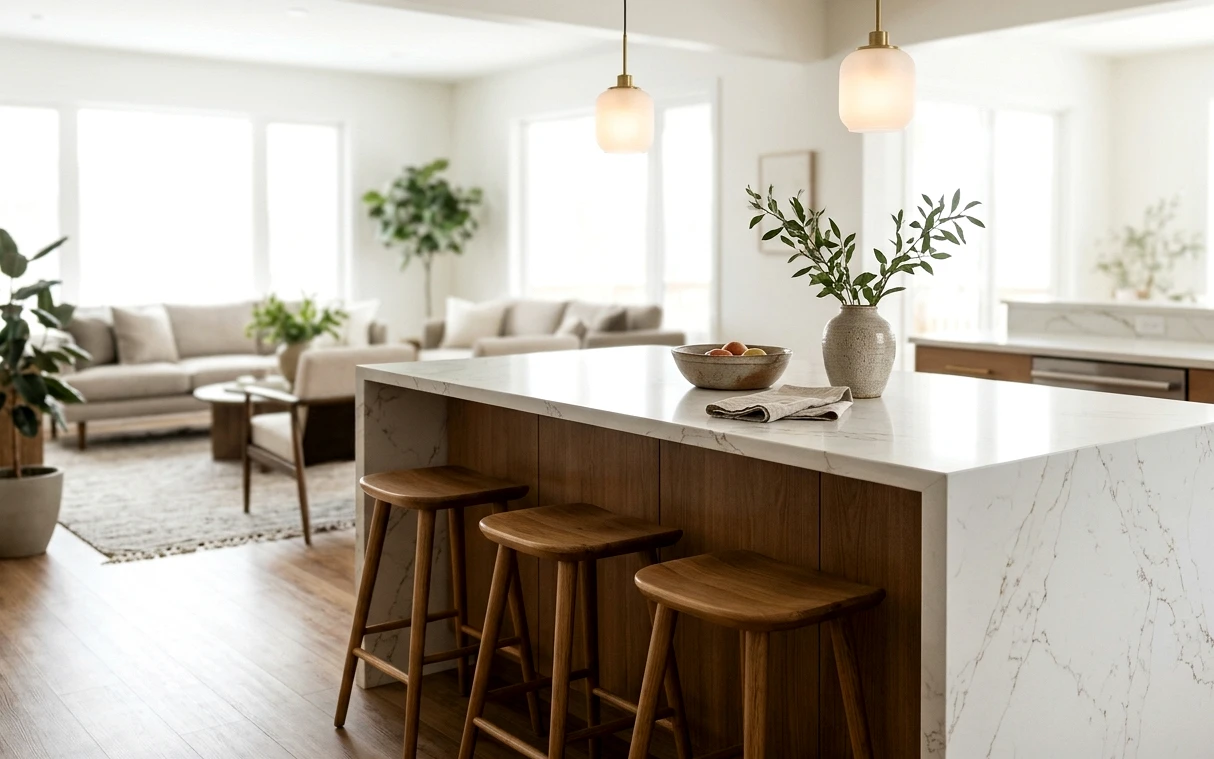
What Quartz Does Well, and Where It Has Limits
Engineered quartz is mostly ground stone bound with resin. That mix makes it nonporous, so it never needs sealing and doesn’t absorb stains like natural stone can. For busy households, it’s the easiest counter to live with. Hard water rings from glasses and drips around the faucet wipe off without etching.
The resin is also its weak point. Quartz doesn’t like direct high heat, and a hot pan set straight on the surface can scorch or crack it. Some quartz colors also fade or yellow slightly with long, direct sun exposure, which matters here. A counter under a big west-facing window in a San Antonio kitchen gets a lot of afternoon sun.
- Use trivets for pans, slow cookers and air fryers, every time.
- Ask whether a color is rated for heavy sun if the counter sits under a large window.
- Avoid outdoor kitchens with standard quartz; UV exposure is too much for most products.
- Skip harsh oven cleaners and bleach-heavy sprays on the surface.
Picking a Quartz Color and Pattern That Fits the Room
Quartz comes in solid colors, fine speckles and bold marble looks with long veins. Solids and speckles hide crumbs and are forgiving at seams. Veined patterns look striking on an island, but the vein direction has to be planned so it lines up across a seam rather than stopping short.
We always recommend seeing a full slab, or at least a large sample, before you choose. A small chip in a showroom tells you little about how a vein will run across a ten-foot island. For a deeper comparison with natural stone, our guide to quartz and granite in Texas heat covers the trade-offs side by side.
Think about the cabinets and floor at the same time. A busy quartz pattern next to a busy floor tile can fight for attention, so most good kitchens let one surface lead and keep the other quiet. Warm whites and soft creams tend to sit better with wood cabinets, while crisp whites and grays pair well with painted or dark finishes.
Seams, Edges and Overhangs: The Details That Show
Quartz slabs come in fixed sizes, so most L-shaped and U-shaped kitchens need at least one seam. A good seam is tight, color-matched and placed where it’s least noticed, often at a sink or cooktop cutout or in a corner. We mark seam locations on the layout drawing and walk you through them before fabrication.
Edge profiles change the feel of a counter. An eased square edge looks modern and resists chips. A mitered edge makes a counter look thicker than it is and suits islands with waterfall ends. Overhangs for seating need support: anything deeper than roughly a foot usually calls for hidden steel brackets or corbels so the slab doesn’t crack under someone leaning on it.
Corner sinks, angled peninsulas and short return walls all affect where seams land. In some cases, a slightly bigger slab or a second slab costs less in the long run than a seam in a spot you’ll look at every day.
From Template to Installation
Countertop work is quick on site, but the steps have to happen in the right order. Here’s the sequence on a typical quartz job.
- Cabinets set and leveled: the template can’t happen until every base cabinet is fixed and level.
- Sink and faucet chosen: the fabricator needs the exact sink model for the cutout.
- Template: a fabricator measures the cabinets digitally or with physical templates.
- Layout approval: you review where seams fall and how the pattern runs across each piece.
- Fabrication: slabs are cut, edged and polished at the shop.
- Install: pieces are set, seams are joined and leveled, and the sink is mounted underneath.
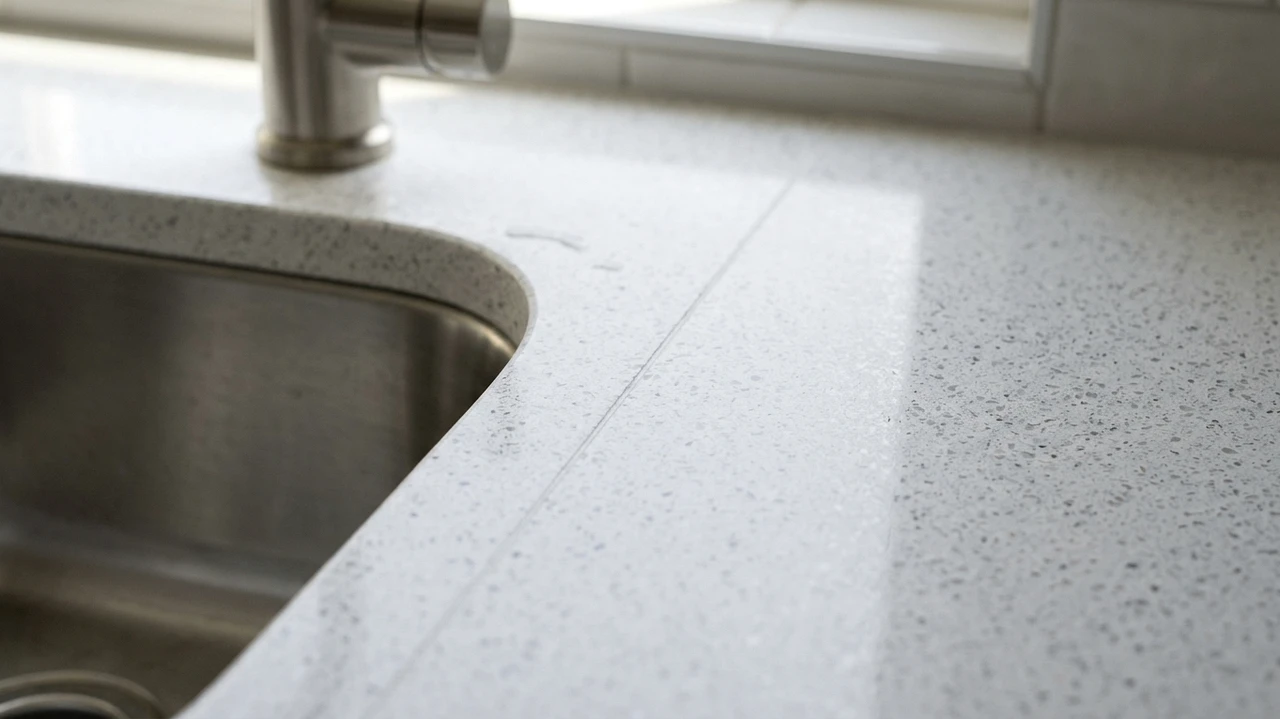
Quartz in Older San Antonio Kitchens
Older homes bring their own challenges. In a 1950s or 1960s ranch, the cabinets may not be level after decades of slab movement on clay soil, and the walls are rarely straight. We check the cabinet tops before templating and shim where needed, because quartz won’t flex to follow an uneven base the way laminate does.
Backsplash planning matters too. If you want a full-height quartz backsplash, outlets and switches have to be placed with the slab in mind. Many clients pair quartz counters with a tile backsplash instead, which is easier to fit around outlets and windows. Our backsplash installation work is usually scheduled right after the counters go in.
Caring for Quartz Over the Years
Daily care is simple: warm water, mild dish soap and a soft cloth. For dried-on spots, a plastic scraper works without scratching. Hard water film around the faucet comes off with a cleaner labeled safe for quartz. Because quartz doesn’t need sealing, there’s no yearly maintenance step.
Avoid cutting directly on the surface, since knives dull fast and fine scratches can show on dark solid colors. If you’re replacing counters as part of a larger project, our full kitchen remodel page explains how counters fit into the bigger schedule. To talk about colors and layout for your own kitchen, give us a ring.
Projects that often go with quartz countertops
Granite Countertops
Granite is natural stone, which means no two slabs match and the one you choose is the one you get. We help you pick slabs in person, lay out the cuts, and install a counter that stands up to hot pans and heavy use.
Kitchen Backsplash Installation
A backsplash is small in square footage and huge in how a kitchen looks. We plan the layout, center the pattern on what your eye sees first, and finish every edge so nothing looks like an afterthought.
Kitchen Island Installation
An island can be the hardest-working spot in the house or the thing everyone bumps into. We size it to your room first, then plan seating, storage, outlets and any sink or cooktop before a single cabinet is ordered.
Kitchen Remodeling
A good kitchen remodel starts with the house, not a catalog photo. We design and build full kitchen remodels across San Antonio, sorting out layout, plumbing, power and permits before anyone picks a cabinet color.
Quartz Countertops questions
Can quartz countertops handle San Antonio summer heat inside the house?
Room temperature isn’t a problem, even on hot days. The risk is direct, concentrated heat from a pan or appliance, and strong direct sunlight over years. Use trivets, and if a counter sits in heavy afternoon sun, ask about colors rated for UV exposure or plan a window shade.
How long does quartz countertop installation take after templating?
Fabrication usually takes 1 to 3 weeks after template, depending on the slab and the shop’s schedule. Installation itself is typically one day for an average kitchen. Plumbing reconnection for the sink and faucet often happens the same day or the next, once the adhesive under the sink has set.
Do quartz countertops need sealing in hard water areas?
No. Quartz is nonporous, so it doesn’t need sealing anywhere, and hard water won’t soak in. Mineral spots sit on top and wipe off with a gentle cleaner. That makes quartz a practical pick for homes across the city where water spotting is a constant battle.
Can you install quartz countertops on existing cabinets?
Usually, as long as the cabinets are sound and can be leveled. Quartz is heavy, so we check that the boxes and any island are strong enough and fastened well. If cabinets are being refaced or painted, we schedule that work around the countertop template.
Is 2 cm or 3 cm quartz better for a San Antonio kitchen countertop?
For most kitchens, 3 cm is the better choice. It’s stiffer, handles island overhangs with less support and needs no plywood underlayment. Thin 2 cm slabs work well for backsplashes and bathroom vanities, or where a client wants a slim look, but they often need a built-up edge to look substantial on a kitchen run.