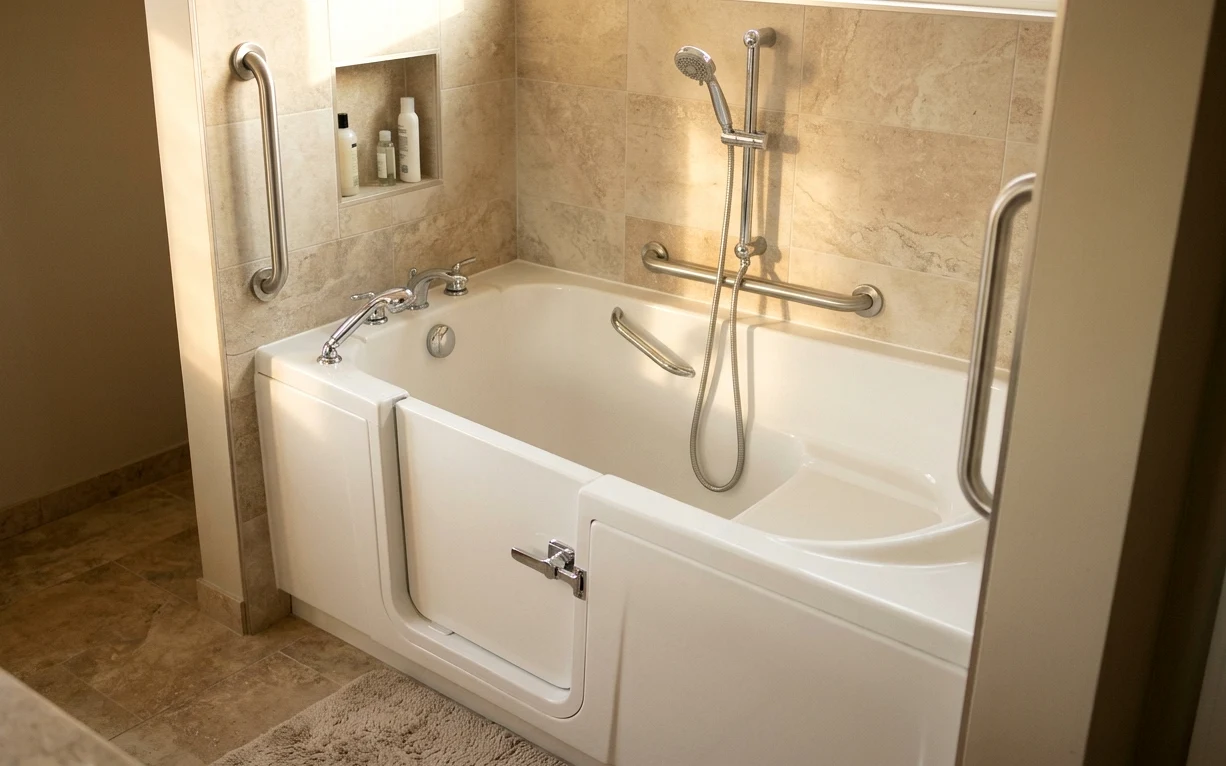
Who a Walk-In Tub Works Well For, and Who It Doesn’t
Walk-in tubs fit people who love a real bath and want to keep taking one at home for years. If climbing over a standard tub wall has started to feel risky, or getting up from the bottom of a tub takes effort, a seated tub with a door solves both problems at once.
They aren’t for everyone, and we’ll say so. You have to step in, close the door, and wait while the tub fills, then wait again while it drains before you can open the door. Some people find that waiting chilly. If quick showers are your habit, a low-threshold or curbless shower is usually a better fit, and we cover that on our accessible bathroom page.
Features Worth Paying For on a Walk-In Tub
Manufacturers pile on options, and some matter far more than others in daily use. These are the ones homeowners tell us they’re glad they chose.
- A fast-drain system so the wait before opening the door is short
- An inward-swinging door for tight bathrooms, outward for easier entry
- A seat at chair height with a textured, slip-resistant surface
- A handheld shower on a slide bar for rinsing hair while seated
- Built-in grab bars on the rim and the door side
- A heated seat or backrest to stay warm while the tub fills and drains
Hot Water Supply Is the Detail Most People Miss
A walk-in tub holds far more water than a standard tub because it’s deep enough to cover you while seated. Many hold 50 to 80 gallons or more. A typical 40-gallon tank water heater can run out before the tub is full, leaving you with a lukewarm bath.
During the walkthrough we look at your water heater size, its age, and how far it sits from the bathroom. Options include a larger tank, a tankless unit, or a tub with an inline heater that holds the temperature once it’s filled. Hard water scale is a factor too: an older tank that’s never been flushed has less usable capacity than its label says.
Inward or Outward Door: Matching the Tub to Your Room
The door swing changes how the whole bathroom works. An inward-swinging door stays inside the tub’s footprint, so it suits small hall baths in 1960s and 1970s homes where the toilet or vanity sits right beside the tub. The tradeoff is that you step in, then step back to swing the door shut, which takes a little more room inside.
An outward-swinging door opens wider and is easier to use if you rely on a walker or a cane, but it needs clear floor space in front of the tub. We tape the swing on your floor during the walkthrough so you can try it before choosing. Left-hand and right-hand versions also matter, because the door should open toward the side you naturally enter from and where a grab bar can be anchored in the wall.
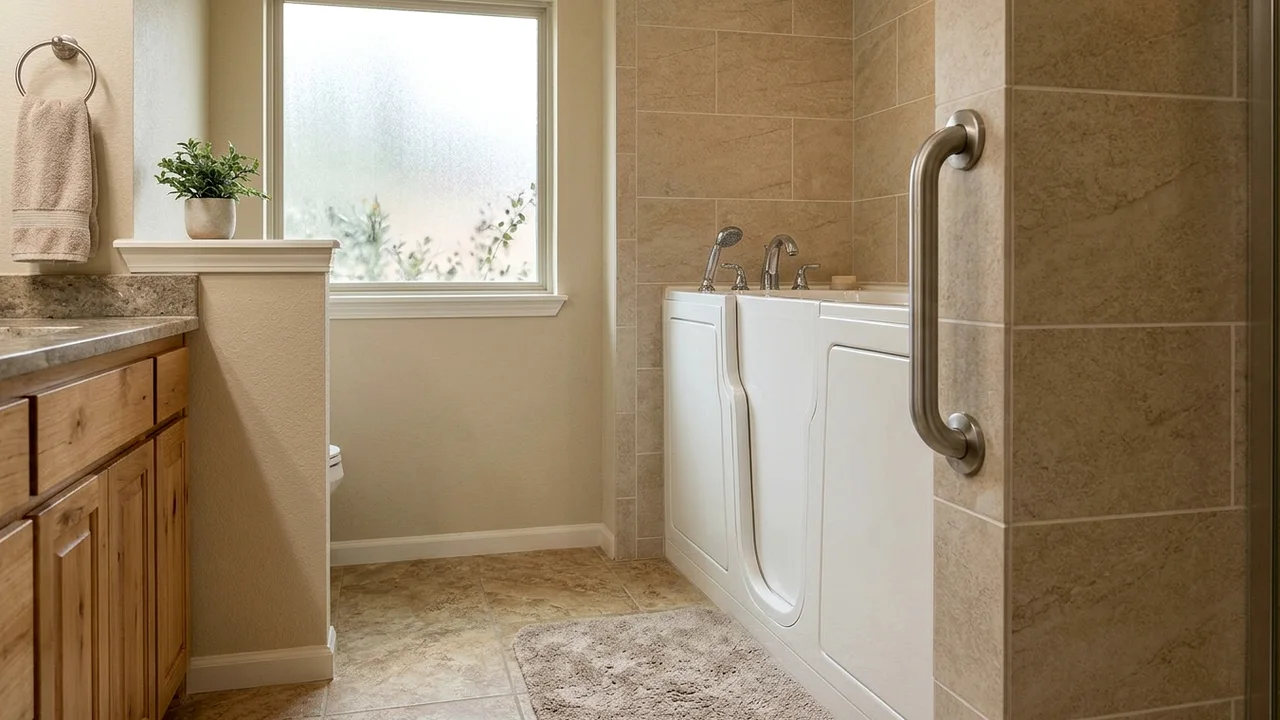
Getting the Tub Into the House and Into the Alcove
Most walk-in tubs are built to fit the same 60-inch alcove as a standard tub, but they’re taller and heavier. We check doorways, hallway turns, and the drain location before anything is ordered.
- Measure the alcove, door openings, and the route from the driveway
- Confirm the drain side and whether the slab drain needs a short adjustment
- Remove the old tub and the lowest band of wall material
- Run a dedicated GFCI circuit if the tub has jets, heater or heated seat
- Set and level the walk-in tub, connect drain, supply and power
- Fill test, check the door seal, and adjust the quick-drain
- Finish the walls with tile, panels or a matching extension kit
Questions to Ask Before You Sign for Any Walk-In Tub
This is a product category with a lot of high-pressure selling. We’d rather you take your time. Ask whoever you’re talking to these questions, including us.
- How long does this exact model take to drain fully?
- What water heater capacity does it need for a hot fill?
- Does it need a dedicated electrical circuit, and is that included?
- How is the door seal replaced if it wears out, and who services it?
- What happens to the wall tile above the tub after install?
Pairing the Tub With Small Safety Changes Around It
The tub is only part of a safer bath. The trip from the bedroom to the tub, the floor surface, and the lighting all matter. We often add a grab bar beside the toilet, a nightlight on a motion sensor, and a slip-resistant floor tile in the same visit. See our grab bar installation page for placement ideas.
A comfort-height toilet, a lever-handle faucet at the vanity, and a wider doorway can follow later if needed. Our aging in place checklist is a good way to think about what to do now and what can wait. Give us a ring and we’ll walk the bath with you.
Projects that often go with walk-in tub installation
Accessible Bathroom Remodel
An accessible bathroom is one you can still use comfortably when your knees, balance or eyesight change. We plan for the way you live now and the way you may want to live later, without making the room look clinical.
Grab Bar Installation
A grab bar only helps if it holds when someone’s full weight lands on it. We place each bar where the person using it actually reaches, then anchor it into framing or blocking, not just drywall or tile.
Bathtub Replacement
A chipped steel tub, a flexing acrylic floor, or a slow leak at the overflow all point to the same fix. We take the old tub out, deal with the drain and wall below it, and set a new one level and sealed.
Curbless Shower Installation
A curbless shower has no step at the entry, just one continuous floor that flows from the bathroom into the shower. It looks open and clean, and it’s easier to walk into at any age. The craft is in the slope.
Walk-In Tub Installation questions
Will a walk-in tub fit in my existing San Antonio bathroom?
Most do. Walk-in tubs are commonly made in 60-inch lengths to drop into the same alcove as a standard tub, with narrower models for small rooms. We measure the alcove and confirm the drain side, and we also check the doorway and hall since the tub has to come in as one piece.
How long do you wait for a walk-in tub to drain before opening the door?
It depends on the model and your drain. Standard gravity drains can take several minutes, while pump-assisted fast-drain systems cut that down substantially. That’s why we recommend a fast-drain and a heated seat or backrest, so you stay comfortable during the short wait.
Does a walk-in tub need a new water heater?
Not always, but often. A deep walk-in tub can use more hot water than a standard 40-gallon tank delivers. We check your tank size and age, and the options include a larger tank, a tankless heater, or a tub with an inline heater that keeps water warm once filled.
Can a walk-in tub also be used as a shower?
Yes. Most models accept a handheld shower on a slide bar, and many people shower seated in the tub. If you want to stand, we can add a shower valve and wall tile above the tub with a curtain. Just remember the door has to stay closed while water is running.
Is a walk-in tub a good idea for a family where only one person needs it?
It can be, as long as everyone is fine with seated bathing or using the handheld shower. In homes with a second bathroom, many families keep a standard shower in the other room. If this is the only full bath, we’ll talk through whether a low-threshold shower would work better for the whole household.