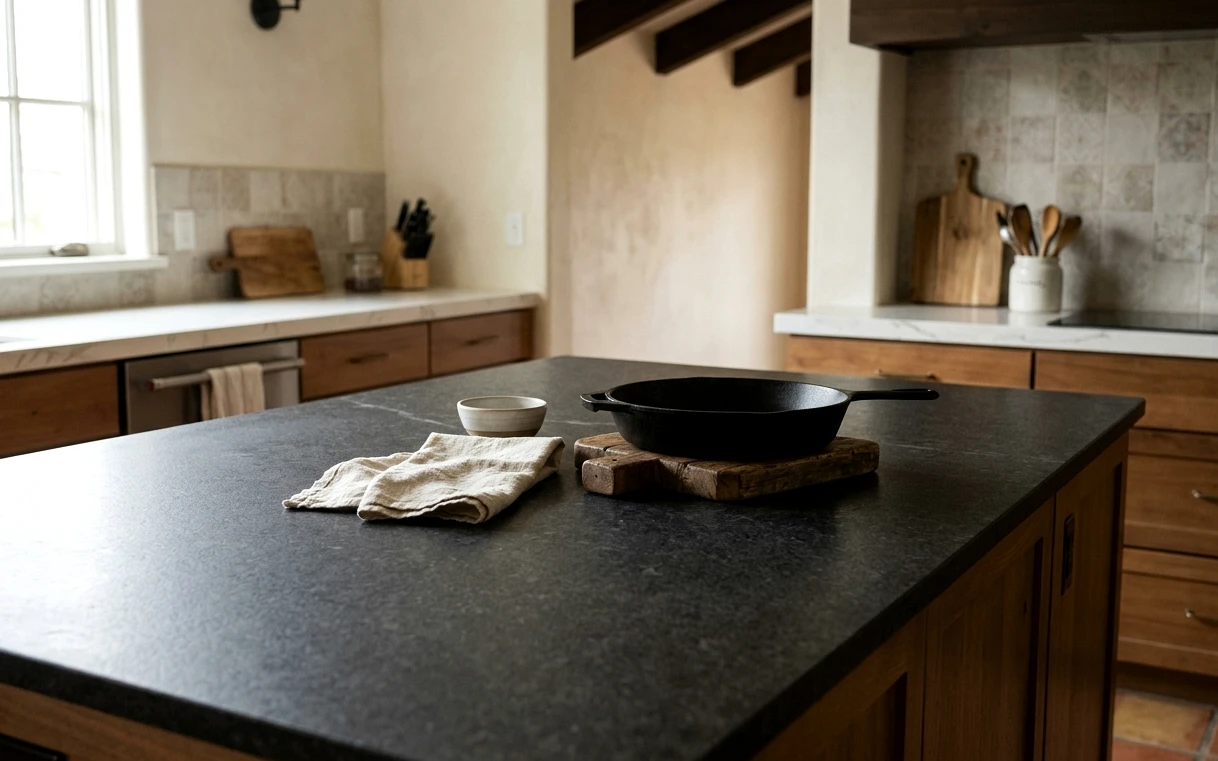
What each countertop is actually made of
Granite is quarried stone, cut into slabs and polished. Every slab is different, and some have dramatic movement that you’ll want to pick in person at the slab yard. It’s porous to a degree that depends on the stone, which is why most granite gets sealed.
Quartz is engineered. Crushed natural quartz is bound with polymer resin and pigments, then pressed into slabs. That resin is what makes quartz nonporous and consistent from slab to slab, and it’s also the reason quartz reacts differently to heat and sunlight.
Hot pans and Texas heat: which counter takes it better
Granite formed under extreme heat, so a hot pan set down briefly won’t hurt the stone itself. The risk is thermal shock in a spot with a hidden fissure, or damage to the sealer, which is rare.
Quartz is different. The resin can scorch, discolor or crack if you set a pan straight from a burner or oven onto it. A trivet solves that completely, but you have to use it every time. If your household tends to slide pans off the range onto the nearest surface, granite is more forgiving.
Ambient heat in a closed-up summer house is not a concern for either one. Even a kitchen that sits warm all afternoon stays far below what would affect quartz resin.
Sunlight, west windows and outdoor kitchens
This is where the choice gets clear. Ultraviolet light can slowly fade or yellow the resin in standard indoor quartz, especially in bright white and pale gray colors. Indoors behind ordinary window glass that’s rarely a visible issue, though a counter under a big unshaded west window may change slightly over the years.
Outdoors, standard quartz is a poor fit. Our patios get hours of direct summer sun, and most manufacturers don’t warrant indoor quartz for exterior use. For an outdoor kitchen, granite, a sealed dense natural stone or an exterior-rated porcelain slab are the safer choices. We cover more of that in our guide to outdoor kitchens in South Texas heat.
Side by side on everyday kitchen life
Beyond heat and sun, the two materials trade small wins. This comparison covers what tends to matter in a working family kitchen.
- Stains: quartz is nonporous and shrugs off wine, oil and turmeric. Sealed granite resists well, but an unsealed light granite can darken under oil.
- Maintenance: quartz needs only soap and water. Granite needs resealing on a schedule that depends on the stone, often every one to three years.
- Scratches and chips: both are hard. Granite is slightly harder, while quartz edges can chip if struck with a heavy pot.
- Hard water: neither etches from mineral spots, unlike marble, so both clean up well with a damp cloth.
- Look: quartz is consistent and great for clean, uniform designs. Granite offers one-of-a-kind movement you cannot copy exactly.
- Seams: quartz seams can be nearly invisible on solid colors. Granite seams depend on how well the pattern is matched across slabs.
What quartz and granite usually cost installed in San Antonio
Prices overlap so much that cost alone rarely decides it. Entry-level granite can be cheaper than mid-range quartz, while exotic granite can cost more than nearly any quartz.
Typical installed ranges run $58 to $112 per square foot for quartz counters and $49 to $118 per square foot for granite. These are planning figures, not quotes.
- The slab itself, its color group and its rarity
- How many slabs the layout needs, and whether seams can be hidden
- Edge profile, from a simple eased edge to a mitered waterfall
- Cutouts for sinks, cooktops and faucet holes
- Removal of old counters and any backsplash damage repair
- Support brackets for wide island overhangs
How each surface pairs with sinks, backsplashes and cabinets
Both materials take an undermount sink well, and both can run up the wall as a full-height backsplash. Quartz is easier to match for a slab backsplash because the color stays consistent from slab to slab. With granite, we lay out the slabs and pick which section goes behind the range so the veining flows rather than jumps.
Weight matters a little. A three-centimeter granite slab and a three-centimeter quartz slab are close, and both need level, solid cabinet boxes underneath. If you’re keeping older cabinets and only replacing the top, we check that the boxes are square and sturdy first. Sagging or out-of-level bases can crack either material during install, and that’s a cheaper problem to fix before stone arrives than after.
Color also plays with light. San Antonio kitchens with big south or west windows get a lot of warm afternoon light, which can make a cool white quartz look slightly blue in the morning and creamy by evening. Look at samples in your own kitchen at a few times of day before committing.
Questions to answer before you visit the slab yard
A short list of honest answers usually points to the right material faster than looking at a hundred samples.
- Will you reliably use trivets, or do pans land wherever there’s room?
- Does any part of the counter sit in direct sun, indoors or out?
- Would you rather never think about sealing again?
- Do you want a uniform look or a slab with strong natural movement?
- Are you matching an island and perimeter, or mixing materials?
- How long is the run, and will seams fall in visible spots?
Our honest take for most San Antonio kitchens
For an indoor kitchen where the household is busy and nobody wants a maintenance schedule, quartz is usually the easier choice. For a serious cook who wants a counter that tolerates hot pans, or for any surface outdoors, granite tends to make more sense.
Plenty of homeowners split the difference. Granite on the perimeter by the range, quartz on the island where kids do homework, or the other way around. If you’re torn, talk it through with us by phone and bring photos of the slabs you’re considering.
More questions on this topic
Can quartz countertops crack from a hot pan in a San Antonio kitchen?
They can. The resin in quartz can scorch, discolor or crack from a very hot pan set directly on it. It’s not common in normal use, but it happens. Using a trivet every time removes the risk. Granite handles brief contact with hot cookware much better.
Is granite or quartz better for an outdoor kitchen in South Texas?
Granite, or an exterior-rated porcelain slab, is the better choice. Standard indoor quartz can fade or yellow in direct sun, and most quartz makers don’t cover it for outdoor use. A dense granite, sealed properly, holds up to our summer sun and heat.
How often should granite countertops be resealed in a San Antonio home?
It depends on the stone. Dense dark granites may need resealing only every few years, while lighter, more porous ones benefit from it yearly. A simple test: drip water on the counter. If it darkens the stone within a few minutes, it’s time to reseal.
Does quartz or granite hold up better to San Antonio hard water spots?
Both handle hard water well, since neither is etched by mineral deposits the way marble is. Spots wipe off either surface with a damp cloth. On dark polished granite, dried water rings show more, so a quick wipe around the sink keeps it looking clean.
Services this guide covers
Quartz Countertops
Quartz gives you a consistent, low-maintenance surface that shrugs off coffee, wine and hard water spots. We plan the slab layout, seams and edges with you, then template and install once the cabinets are set and level.
Granite Countertops
Granite is natural stone, which means no two slabs match and the one you choose is the one you get. We help you pick slabs in person, lay out the cuts, and install a counter that stands up to hot pans and heavy use.
Outdoor Kitchen Construction
An outdoor kitchen here has to survive months of triple-digit afternoons, sudden downpours and a sun that bleaches anything left uncovered. We build them with shade, heat-tolerant materials and properly run utilities from the first sketch.
Keep reading
Reface, Paint or Replace Your Kitchen Cabinets: A Decision Guide
The answer usually depends on three things: what the cabinet boxes are made of, whether you like the layout, and how long you plan to stay. Here is how to test each one.
Keeping New Faucets, Glass and Showers Clear of San Antonio Hard Water
Our water comes from limestone, and it leaves a trace on everything it touches. A few choices made during a remodel decide how your new fixtures look a year from now.
Slab Foundations and Moving Drains During a San Antonio Remodel
Most San Antonio homes sit on a concrete slab, and every drain runs through it. Moving one is doable, but it helps to know what happens under the floor before you approve a new layout.