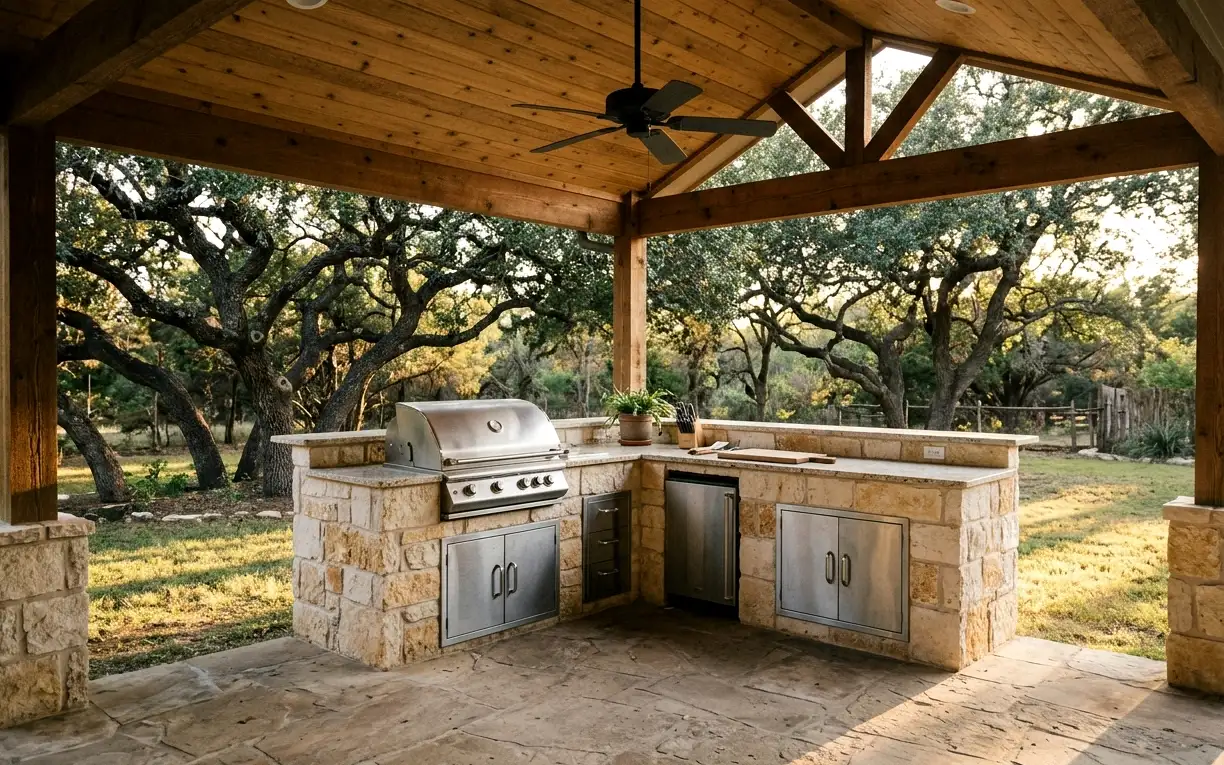
Shade first, everything else second
Summer afternoon sun in San Antonio is the single biggest factor in whether an outdoor kitchen gets used. A grill island in full western sun can be too hot to touch from June through September, and the cook will be miserable. That’s why we start every outdoor kitchen plan by asking where the shade comes from.
A solid roof extension or pavilion gives the most protection and can hold a ceiling fan and lights. A pergola with slats gives partial shade and a lighter look. Big live oaks help, but leaves and acorns fall into everything, so plan for covers and easy cleaning.
- Track where the sun sits at 5 p.m. in July before picking a spot.
- Favor the east or north side of the house where you can.
- Plan a solid roof if you want fans, lights and TVs outside.
- Leave room under any roof for grill smoke and heat to escape.
Countertops that handle sun and heat
Direct sun narrows the countertop choices. Standard indoor quartz can fade or discolor in ultraviolet light, so it’s generally not used outdoors. Our guide on quartz versus granite in Texas heat explains why in more detail.
Granite is the most common choice. Darker colors absorb more heat and can get uncomfortably hot in direct sun, so under a roof they’re fine, but in full sun a lighter stone stays cooler. Porcelain slab rated for exterior use is another strong option. It resists heat, stains and UV well, though edges need care. Concrete counters work but need sealing and can crack if the base moves with our clay soil.
Bases and cabinets that won’t rot or rust
Wood framing has no place in an outdoor kitchen here. Humidity, rain and termites take it apart. Most durable islands use steel stud or concrete block framing with a stone, stucco or brick finish that matches the house.
For storage, marine-grade polymer and 304 stainless steel doors and drawers hold up best. Cheaper stainless can rust in a few seasons, especially near a pool. Inside, plan for some airflow so moisture doesn’t collect.
- Concrete block or steel stud framing, never wood
- Stone veneer, stucco or brick that ties to the house exterior
- 304 stainless or marine polymer doors and drawers
- Vented storage to avoid trapped moisture
- A footing or slab that’s solid enough for the island’s weight
Appliances worth the space outdoors
Start with the grill and add only what you’ll use. Every appliance adds cost, power or gas needs, and something else to clean.
Outdoor-rated refrigerators are built to cool in high ambient heat. Indoor fridges placed outside often run constantly in summer and fail early. The same goes for ice makers. A side burner is handy for sauces and boiling, and a smoker or flat-top griddle suits plenty of Texas cooks better than a pizza oven.
- Built-in gas grill, the anchor of most outdoor kitchens
- Outdoor-rated refrigerator or beverage center
- Side burner or flat-top griddle
- Sink with hot and cold water, if utilities reach
- Vent hood if the grill sits under a solid roof
- Trash pull-out to keep pests and flies away
Laying out the cooking, prep and serving zones
Outdoor kitchens work best with the same logic as indoor ones: a hot zone, a prep zone and a place for people to gather that isn’t in the cook’s way. Give the grill at least a couple of feet of counter on each side for platters and tools.
Keep the grill’s smoke away from the back door and seating. In San Antonio, summer breezes usually come from the south and southeast, so placing the grill downwind of the main seating area keeps smoke off guests most evenings. A raised bar ledge on the guest side lets people sit and talk without crowding the cook, and it hides the clutter of prep work.
Think about the walk to the indoor kitchen as well. The shorter and flatter the path, the more often you’ll carry food out and actually cook outside.
Utilities: power, gas, water and drainage
Running utilities is where outdoor kitchens get expensive, and it’s best planned before the patio is poured. Gas to the grill, power for lights, a fridge and outlets, water supply and a drain for the sink all need a path from the house.
Many San Antonio homes already have a natural gas line nearby. Otherwise a propane tank works. Electrical runs outside need weatherproof outlets and GFCI protection. A sink drain has to go somewhere approved, which is often the hardest piece, and a dry sink with no plumbing is a common way to keep costs reasonable.
Hard water applies outside too. An outdoor faucet scales quickly, so pick a simple model that’s easy to clean.
Typical outdoor kitchen costs in San Antonio
These are planning ranges, not quotes. Size, shade structure and utilities matter more than anything else.
- Simple grill island with counter and storage: $14,650 to $26,300
- Mid-size kitchen with grill, fridge and side burner: $27,800 to $47,400
- Covered kitchen with sink, fridge, fan and lighting: $48,900 to $68,900 and up
- Shade structures, such as a pergola or roof, are often priced separately
- Long utility runs, new patio slabs and permits add to any level
Upkeep through the seasons
A little routine keeps an outdoor kitchen looking new. Clean and cover the grill after use. Reseal granite once a year. Wipe stainless with a cleaner made for it, and check gas connections each spring.
Before hail season and summer storms, make sure covers are on and loose items are stored. In Hill Country areas like Boerne and Helotes, keep an eye on wasps and scorpions setting up in cabinets.
If you’re planning an outdoor kitchen build and want to work out shade, materials and utilities for your yard, call for a walkthrough.
More questions on this topic
Can I use an indoor refrigerator in a San Antonio outdoor kitchen?
It’s not a good idea. Indoor refrigerators are designed for room temperature and struggle when summer heat reaches the upper 90s and beyond. They run constantly, cool poorly and fail early. An outdoor-rated unit is built for high ambient heat and moisture.
Does an outdoor kitchen in South Texas need a roof or pergola?
It doesn’t have to, but it makes a big difference in how often you use it. Without shade, cooking in a July afternoon is rough, and counters and appliances get very hot. A solid roof offers the most protection, while a pergola gives partial shade at a lower cost.
Do outdoor kitchens in San Antonio need permits?
Often, yes, when gas lines, electrical circuits, plumbing or a roof structure are involved. The rules depend on your city, and HOAs in neighborhoods like Stone Oak may also review the design. Our permit overview explains the general rules.
Services this guide covers
Outdoor Kitchen Construction
An outdoor kitchen here has to survive months of triple-digit afternoons, sudden downpours and a sun that bleaches anything left uncovered. We build them with shade, heat-tolerant materials and properly run utilities from the first sketch.
Granite Countertops
Granite is natural stone, which means no two slabs match and the one you choose is the one you get. We help you pick slabs in person, lay out the cuts, and install a counter that stands up to hot pans and heavy use.
Kitchen Appliance Installation
A new appliance is only as good as the opening, circuit and connection behind it. We handle the cabinet changes, wiring, gas and ductwork that turn a delivery into a working kitchen.
Keep reading
Kitchen Remodel Cost in San Antonio: Ranges by Scope
Planning ranges for San Antonio kitchens, sorted by how much of the room actually changes, with the handful of decisions that push a budget up or hold it steady.
How Much a Bathroom Remodel Costs in San Antonio
A powder room and a primary suite are different projects with different math. Here is how the numbers usually break down by room type in San Antonio homes, and why.
Should You Swap Your Tub for a Shower? An Honest Look at the Tradeoffs
Taking out a tub you never use sounds like an easy call. Usually it is. Sometimes it isn’t, and the reasons have more to do with who lives in the house than with tile.